
A social media plan for a technical firm takes 10 steps and one principal’s Thursday morning.
- Pick one goal with a number and a date.
- Pick the one buyer who signs the contract.
- Post one answer a week to the questions that the buyer asks in meetings, from a person’s LinkedIn profile, in the buyer’s own words, with the specs second.
Count 3 things:
- profile views from the buyer’s job title,
- comments from people who could sign,
- and inquiries that mention a post.
Check the plan every quarter and change one thing.
The Social Media Plan for Technical B2B Firms
A boardroom, Tuesday, 8:10am. The principal says the firm needs more visibility. Three project managers nod. The receptionist, who also runs payroll, is asked to look into social media. The meeting moves on to the parking lot.
The American Marketing Association published eight steps for building a social media plan.[1] Good list. Written for a company with a marketing team and a person whose whole job is Instagram.
Your firm has the people in that boardroom and a company page with 212 followers, most of whom work there.
Same eight steps, rebuilt for you, plus two the AMA list skips: the words you use, and the chat window your buyer now opens first.
Step 1. Pick one goal with a number on it
The AMA says make goals specific, measurable, attainable, relevant and time-bound, and start with one to three.[1]
Agreed, with one edit. Start with one.
Visibility is hard to check on April 1. Write the goal so you can check it. For an engineering firm the goal is a specific kind of client calling about a specific kind of job:
“Three inquiries from food manufacturers about plant retrofits by March 31.”
A number, a buyer, a job type, a date. On April 1 you will know whether it worked, which is more than most firms can say about the golf tournament sponsorship.
Step 2. Know the one person who signs
The AMA recommends audience research. Demographics, analytics, social listening, buyer personas.[1]
You can skip most of that, because you already know the buyer. You have sat across a table from this person. A plant manager with a line that stops twice a shift. A developer with a permit stuck at the city. A facilities director who has to explain a $4 million mechanical budget to a board that thinks HVAC is a typo.
Pick one. Then write down, from memory, the five questions that person asked in the last meeting before signing. Those five questions are your audience research, and the whole exercise cost you a coffee.
Forrester’s 2026 study of business buying puts the typical decision at 13 people inside the company, plus 9 outside, and the number goes up for bigger purchases.[2] All 22 matter at the end. Your posts talk to the one who starts the conversation and carries your name to the rest.
One buyer. Write to that person in every post. The other 21 will read along.
Step 3. Choose one channel, and it is LinkedIn
The AMA says pick one to three channels where the audience is active.[1]
For a social media plan for engineering firms the answer is one. The plant manager, the developer and the facilities director are on LinkedIn, during work hours, with a work problem open in another tab. Nobody is choosing an engineering firm from a TikTok. Save the dance for the Christmas party.
Gartner surveyed 646 B2B buyers in late 2025 and found 67% prefer to buy without talking to a sales rep at all.[3] The buyer checks you alone, on a screen, before anyone at your firm knows a search happened. The profile is the first meeting.
So post from a person’s profile. People trust people. A logo cannot shake hands. A project manager’s profile with a real face, a real jobsite photo and a real opinion about retrofits does the job. The company page with the drone shot of the office is a drone shot of the office.
Step 4. Count what the buyer does, and skip the rest
The AMA ties measurement to goals: reach and follower growth for awareness, interaction for interest, conversions for sales.[1]
For your firm, count three things.
Profile views from the buyer’s job title. LinkedIn shows you this for free.
Comments and messages from people who could sign a contract. Twelve likes from your own staff count for zero. Lovely people. Already on payroll.
Inquiries that say “I saw your post about the retrofit.”
That third one needs a question on every inquiry form and every first call: “What did you look at before you called?” It costs nothing, and it tells you which post did the work.
Step 5. Post what the buyer asks you in meetings
The AMA suggests content pillars: educational, entertaining, user-generated, promotional, thought leadership.[1]
Five pillars is four too many for a firm where the person posting also stamps drawings.
One pillar. The five questions from Step 2, answered in plain words, one question per post, in the order the questions come up in a real meeting.
Here is the shape for a mechanical firm. Swap in your own jobs.
Buyer question: “Will the line have to stop during the retrofit?” Post: What day one of a retrofit looks like when the line keeps running. What gets planned around the shift schedule, what gets done at 2am, and the one decision that needs the shift supervisor in the room.
Buyer question: “Why did the last firm’s quote double halfway through?” Post: The three places a retrofit quote grows, and the one question to ask before signing that stops two of the three.
Buyer question: “Who is going to be on my site?” Post: The name and face of the project manager who shows up on day one, and the last job that person ran at your size.
Then say the same thing again a week later, from a different job. And again. You will be bored of your own message months before your buyer notices it, and boredom is the sign it is working. The buyer reads one post in five, on a phone, between meetings. Repetition is how your name sticks.
Step 6. Write in the buyer’s words
The AMA list has no step for this. It needs one.
Open your website and read the services page out loud. “Full-service mechanical, electrical and plumbing design.” “Multidisciplinary engineering for industrial clients.” Now picture the facilities director reading that at 9:45pm with a budget meeting in the morning and a board that wants to know why the number went up.
The buyer has a line that stops twice a shift, a permit stuck at the city, a number that went up. Write about those, in those words. Keep the specs. Put the specs second.
The same Gartner survey found buyers who felt confident in the decision were twice as likely to call the deal a high-quality one. Gartner’s name for what builds that confidence is value clarity: the buyer can see what changes in that buyer’s own job.[3] Plain words are how a buyer gets there. The spec sheet comes along afterwards to prove it.
A test that costs nothing: read the post to the shift supervisor. If the supervisor can repeat it back, post it. If the supervisor asks what a word means, the facilities director will too, and the facilities director will ask a competitor.
Step 7. Schedule less than you think
The AMA says use a content calendar, set a realistic cadence, and review it.[1]
Realistic, for an engineer with a deadline, is one post a week. One post a week for a year is 52 answers to buyer questions, sitting on a profile, waiting for the plant manager who got your name from a colleague over coffee and is now checking you out at 9:45pm.
Put it in the calendar like a site visit. Thursday, 7:30am, twenty minutes, one post. Treat it as a meeting with the buyer, because that is what it is.
Step 8. Give the chat window something true to say
New since the AMA list went up. The buyer’s first stop is now a chat window.
Forrester’s 2026 study found generative AI search has become the starting point for business buyers, and that the answers come back incomplete or unreliable enough that buyers go looking for a trusted source to confirm what the AI said.[2] Gartner’s survey of 645 buyers found 45% used GenAI during a recent purchase, mostly to gather information on vendors, and 51% expect to run into misleading information from it. So 69% take what the AI said to a human and ask if it is true.[4]
Here is what that looks like on a Tuesday night. The facilities director types “mechanical engineering firms that do plant retrofits in Alberta” into a chat window. The answer is built from whatever is public about your firm. If what is public is a services list and a 2019 project gallery, your firm gets one thin paragraph, and the competitor with 52 plain-language posts about retrofits gets the long one.
Then the human check. The buyer opens LinkedIn to see if the firm is real. A person’s profile with a face, a jobsite photo and a post about the last retrofit is the confirmation.
Your 52 posts do two jobs. Feed the chat window a true description of what you do. Give the human check a real person to find.
Step 9. Look at three competitors, then write what is missing
The AMA says audit three to five competitors and find a way to differentiate.[1]
Do it in twenty minutes. Open the profiles of the three firms you lose to most. Read the last ten posts on each.
You will find a ribbon cutting, a 30-year anniversary, a safety award, a photo of a trade show booth, and a welcome to the new hire. Zero posts answering a buyer question.
Differentiation, for a technical firm, is the plain answer to the question every competitor avoids because answering it sounds like admitting things go wrong on jobs. Things go wrong on jobs. The buyer knows. The firm that says so first, and explains what it does about it, gets the call.
Step 10. Check every quarter, change one thing
The AMA recommends regular performance reviews, testing one variable at a time, and a full review every 6 to 12 months.[1]
Each quarter, three questions.
Did anyone with the right job title call, and what did that person look at first? Which post got a comment from a possible buyer? Which post got twelve likes from staff and nothing else?
Make more of the first two. Change one thing at a time: the opening line, the job type, the day you post. Change two at once and you will never know which one worked, and you will be back in the boardroom on a Tuesday saying “visibility.”
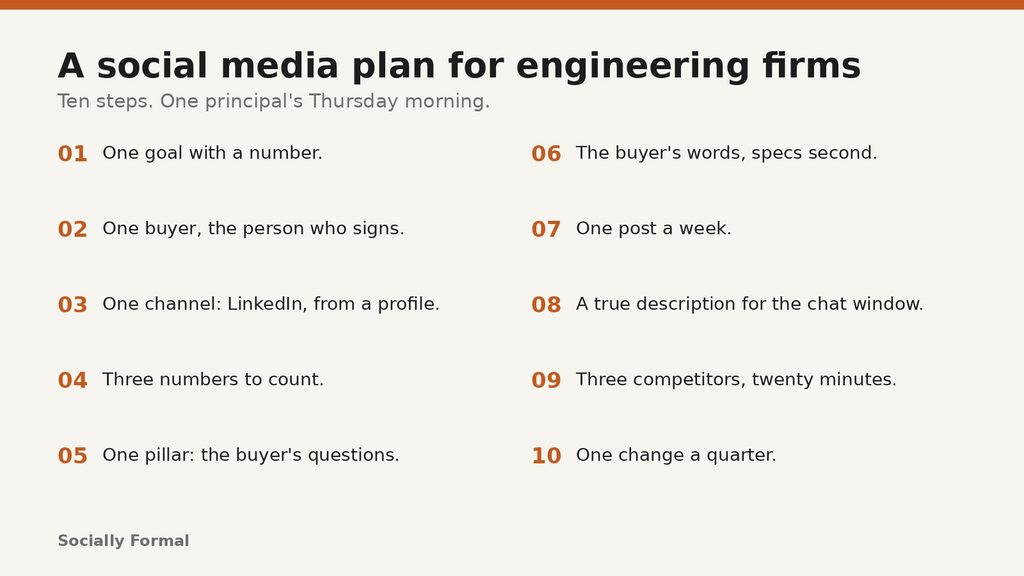
The social media plan for engineering firms, on one page
One goal with a number. One buyer. One channel, LinkedIn, from a person’s profile. Three numbers to count. One pillar: the questions the buyer asks you. The buyer’s words, specs second. One post a week. One true description for the chat window, one real face for the check. Three competitors, twenty minutes. One change a quarter.
That is a social media plan for engineering firms: the AMA’s eight steps with the parts a small firm does not need taken off, and the two parts it cannot skip added back. What is left fits in one principal’s Thursday morning.
Start with the five questions. Write the first one down tonight.
Sources
- American Marketing Association, “How to Build a Winning Social Media Strategy in 8 Simple Steps,” Marketing News, April 24, 2025. https://www.ama.org/marketing-news/social-media-marketing-strategy/
- Forrester, “The State Of Business Buying, 2026,” press release, January 21, 2026. https://www.forrester.com/press-newsroom/forrester-2026-the-state-of-business-buying/
- Gartner, “Gartner Sales Survey Finds 67% of B2B Buyers Prefer a Rep-Free Experience,” press release, March 9, 2026. Survey of 646 B2B buyers, August to September 2025. https://www.gartner.com/en/newsroom/press-releases/2026-03-09-gartner-sales-survey-finds-67-percent-of-b2b-buyers-prefer-a-rep-free-experience
- Gartner, “Gartner Survey Finds 69% of B2B Buyers Turn to Sales Reps to Validate AI-Generated Insights,” press release, May 20, 2026. Survey of 645 B2B buyers, August to September 2025. https://www.gartner.com/en/newsroom/press-releases/2026-05-20-gartner-survey-finds-sixty-nine-percent-of-b-two-b-buyers-turn-to-sales-reps-to-validate-ai-generated-insights
GET IN TOUCH